Case Study 02 · Self-Initiated · Product Strategy
5 min read
CarX
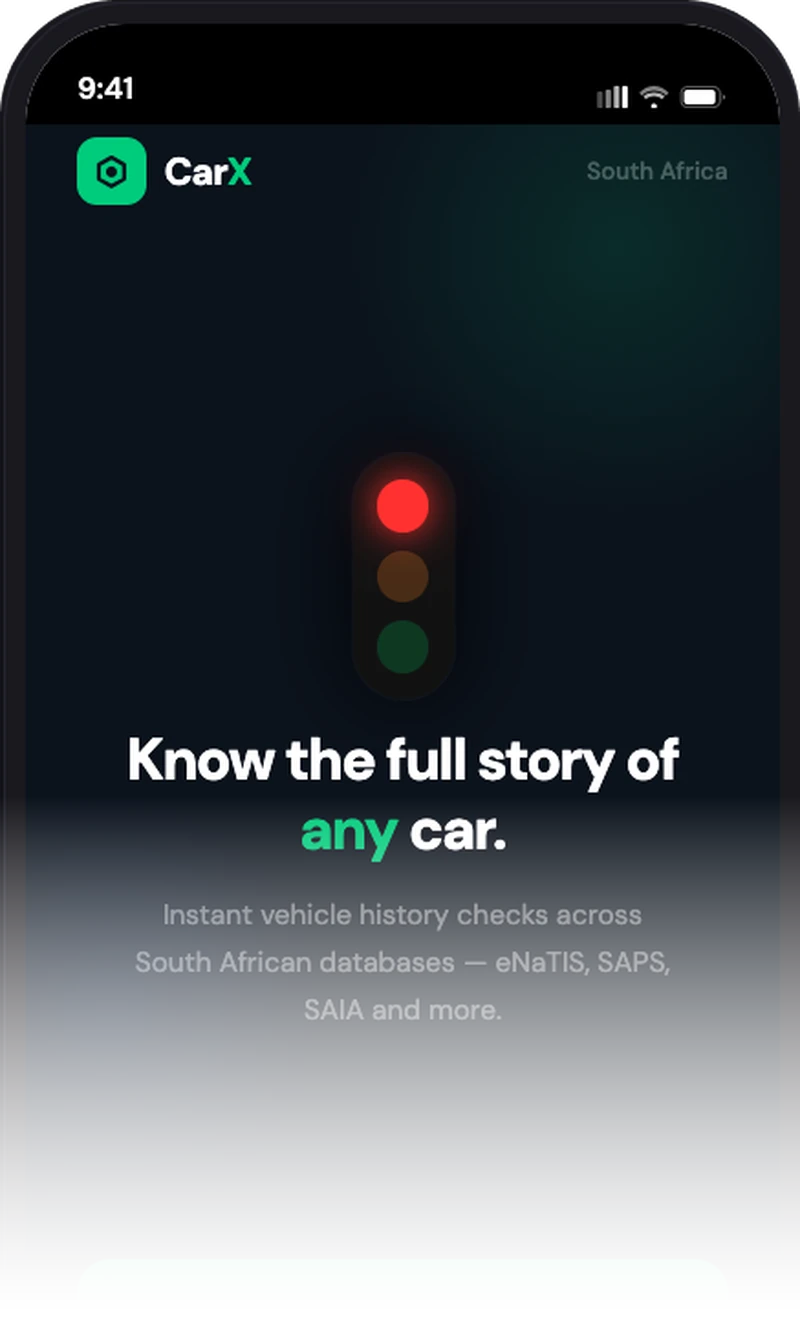
South Africa moves around 400,000 used cars a year. Any one of them can hide a Code 2 write-off, and CarX surfaces it before the money changes hands — a concept I took from market thesis to workable prototype on my own.
Overview and Impact
Problem
Buying a used car here means trusting a stranger's account of a vehicle's past. Odometer tampering, undisclosed write-offs, outstanding finance and stolen-vehicle flags are all matters of public and commercial record — but that record sits fragmented across eNaTIS, SAPS, SAIA and the insurers, effectively out of reach of the person who needs it most.
What I built
The Problem & The Goal
The Challenge
Those sales run against roughly 180,000 new ones a year, on a national fleet of about 12 million. Only around 3 million of those carry insurance, so a large share of damage history never generates a claim record at all.
CarVertical is the closest thing to a competitor. It proved the model in Europe and the US: aggregate the fragmented record, sell the buyer certainty. Its South African page exists, but its depth on locally registered cars is thin — it is strongest on imports carrying European or US histories, which is not what most South African buyers are standing in front of on a Saturday morning.
The gap isn't the business model. It's local data.
Objectives
- Make a fragmented record legible to a non-expert in under a minute.
- Deliver a verdict that reads instantly — before any detail is read.
- Build for local reality — eNaTIS, SAPS, SAIA, Code 2 classifications, not imported equivalents.
- Prove it as something you can use, not a static mockup.
Discovery and Research
Decoding the incumbent
CarVertical launched in 2017 by selling a data product as consumer protection, and entered each market the same way: aggregate whatever records that country actually held, then treat every market as its own negotiation.
The instructive move was the US, where it became a listed NMVTIS-approved provider and unlocked legal access to state title records. The South African equivalent — formal RTMC and eNaTIS recognition — is the highest-leverage move any local entrant could make.
Defining the local checks
Six checks, each designed to pull from a South African source and matched to a real way buyers get caught out.
Definition and Ideation
The core design problem
Vehicle history data is dense, technical and boring. The person who needs it is not a data analyst — they're standing in a driveway with a seller watching them, trying to decide.
So the verdict comes first, and everything else sits underneath it.
The traffic light
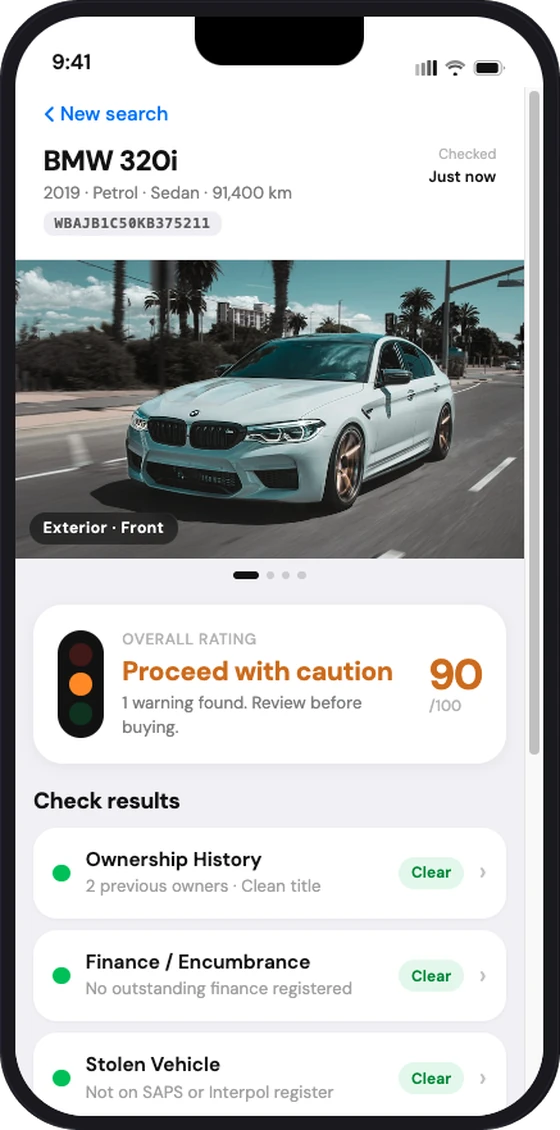
A physical traffic light on the results screen — red, amber, green — carries the outcome before a single word is read, with a score out of 100 beneath it and the detailed checks below that. The metaphor needs no explanation and no legend.
The example vehicle rates amber: five clean checks, one Code 2 write-off flag. Not a rejection, not a green light. Proceed with caution, and go look at these specifics.
Five Screens, One Decision
Visual direction
Deep navy with a green accent — trustworthy without being generic, and deliberately more considered than a classifieds listing, since the product is asking to be trusted with a decision worth tens of thousands of rand.
Native, not wrapped
iOS conventions throughout: status bar, card hierarchy, sheet transitions, system-native motion. It should feel like something already installed on the phone, not a web app in a wrapper.
01 — HomeThe landing page, where a check starts.
you buy.
2019 BMW 320i
Clear2017 VW Polo
Warning2021 Toyota Hilux
Clear02 — SearchScan the VIN or type it in.
03 — ScanThe scan screen, using the phone camera.
04 — LoadingThe checks the app runs, ticked off as each completes.
EXTERIOR · FRONT
2 previous owners · Clean title
No outstanding finance
Code 2 damage flag detected
Consistent across 4 records
05 — ResultsThe output: verdict, score, and the detail beneath it.
↔ Drag to move through the journey
Built, Not Mocked
Coded, not clicked through
This is not a clickable Figma file. The prototype runs as real code:
- Real state management
- Directional screen transitions
- Expanding check rows
- A sequenced loading animation
A static mockup shows what a product might look like. This shows how it behaves.
How it was built
The idea is my own: the market thesis, the six checks, the traffic-light system.
The prototype was implemented with AI, which freed up the time to test whether the idea actually held up.
Progressive disclosure, working
The results screen has to serve two people at once — someone who wants a yes or no in three seconds, and someone who wants to know exactly what happened to the car in March 2021.
The traffic light answers the first. Tapping a check row answers the second, without the detail ever getting in the first person's way.
Where It Stands
Current state
A validated concept with a workable prototype. The gap is real: CarVertical's local depth is thin and the South African records exist.
The route to viability runs through RTMC and eNaTIS partnership, which is a commercial and regulatory problem rather than a design one.
Next: put the prototype in front of used-car buyers and watch where their eyes land on the results screen. The traffic-light hypothesis is confident but untested. Then the drill-down and dispute flows.
Lessons
Research before pixels, even on a personal project. The competitive teardown produced the sharpest insight in the whole concept: the gap is not the business model, it is local data depth.
AI is a tool that shortens the distance. It will not find a market gap or decide that a traffic light beats a data table — that thinking is still the designer's. What it does is close the distance between having an idea and being able to show it.
Have a go yourself
A workable prototype, running right here — not a video and not a slideshow.
- Start on the home screen.
- Tap Check a Vehicle.
- Enter any VIN, scan a vehicle, or pick a recent check.
- Watch the databases resolve one by one.
The report at the end is where the argument lives. The traffic light gives you the verdict, and every check row opens into the detail behind it.
Best viewed on desktopThe interactive prototype is desktop-only — open this page on a larger screen to try it.